
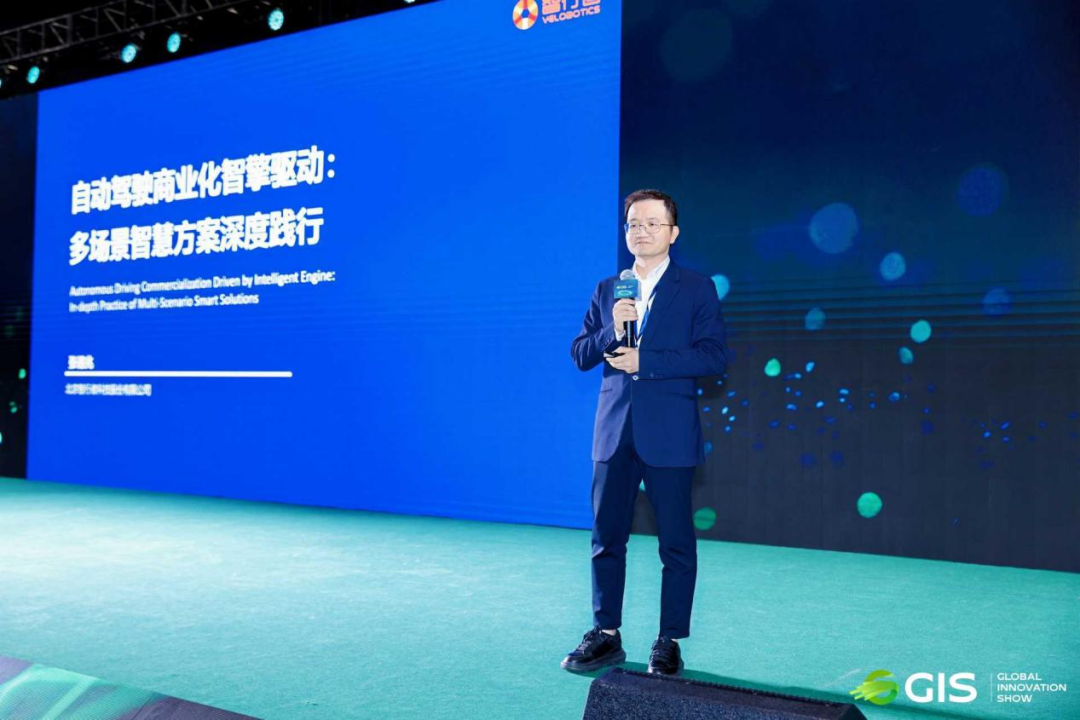
“A 64-channel LiDAR sensor was priced at $100,000 a decade ago—roughly the cost of a Tesla vehicle. Today, it only costs a few thousand Chinese yuan.” On December 3rd, at the GIS Global New Energy Industry and Future Mobility Summit, Zhang Dezhao, Chairman and CEO of Velobotics, opened his speech with the dramatic price plunge of core sensors to illustrate the profound transformation underway in the autonomous driving industry.
Beyond highlighting the striking downward trend in the cost of critical autonomous driving components, Mr. Zhang also projected that the industry will reach the economic parity point between autonomous driving and human-driven vehicles around 2027. As a pioneer among China’s early autonomous driving entrepreneurs, he has steered Velobotics to emerge as a key provider of unmanned driving solutions for specialized sectors, forging a differentiated path in commercialization.
GIS
Technological Leap: From $100,000
LiDAR to End-to-End Road Testing
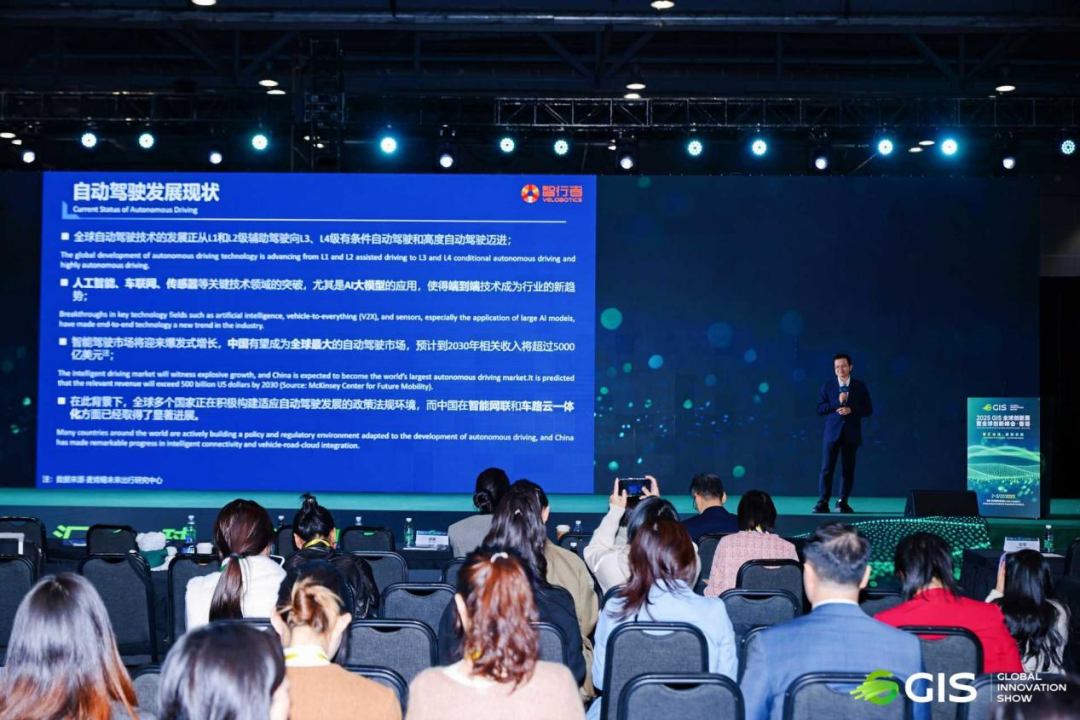
Zhang Dezhao reviewed the development trajectory of autonomous driving technology: globally, autonomous driving is transitioning from L1 and L2 assisted driving to conditional and highly autonomous driving, with its commercialization process accelerating steadily.
"Particularly, the application of large AI models has made end-to-end technology a new industry trend," he stated.
The advancement and cost reduction of sensor technology are particularly remarkable. "A decade ago, a 64-channel LiDAR would cost us $100,000, but now it only costs a few thousand RMB," Zhang Dezhao illustrated the maturity of the industry's core hardware with this direct comparison.
Meanwhile, data processing and algorithms—the core of autonomous driving—have also seen significant improvements in complex environment handling capabilities, thanks to breakthroughs in large model technologies.
In terms of algorithm architecture, the industry is undergoing a transformation from modular systems to end-to-end systems.
Zhang Dezhao disclosed that Velobotics has achieved substantial progress in this field: "In April 2024, we joined hands with Tsinghua University to complete China’s first end-to-end autonomous driving road test on real vehicles, which was conducted on public roads such as Wudaokou area adjacent to Tsinghua University."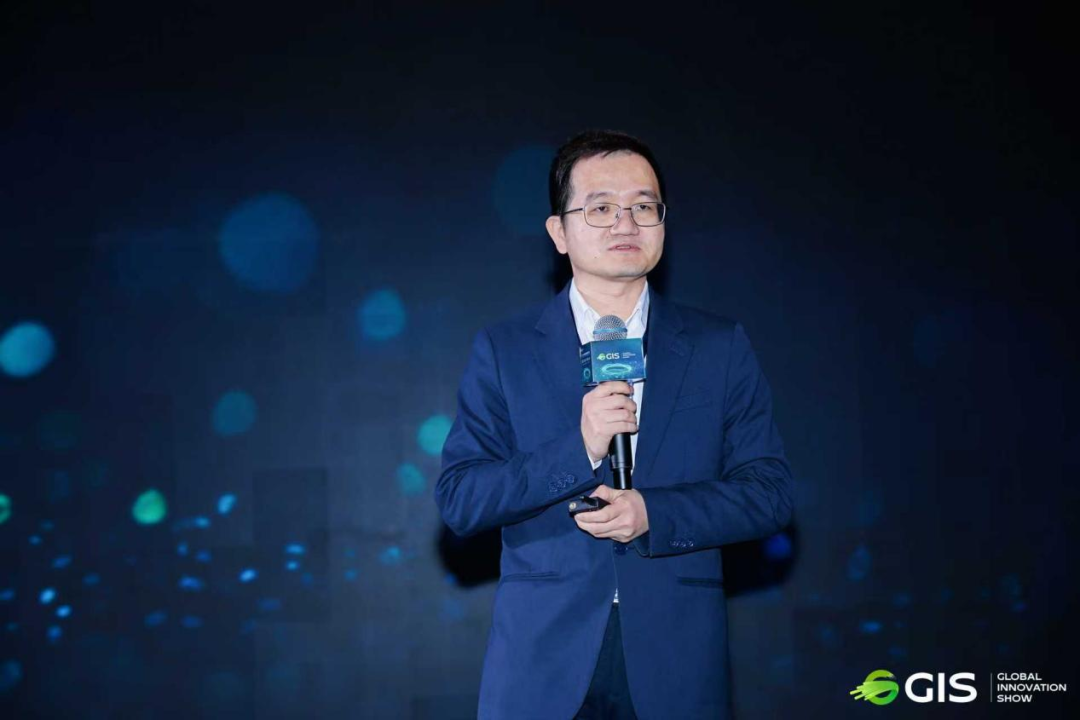
GIS
Route Debate: Vehicle Intelligence vs.
Intelligent Connectivity?
There has long been a divergence in the industry regarding the two technical routes: "Vehicle Intelligence" and "Intelligent Connectivity". Addressing this, Zhang Dezhao clearly stated: "The two are not contradictory. Vehicle Intelligence is the primary stage of Intelligent Connectivity." He specifically pointed out that even Tesla, which is regarded by the outside world as a representative of the "pure vision school", actually adopts a "vehicle-cloud integration" route.
Zhang Dezhao emphasized the four core advantages of China's distinctive "vehicle-road-cloud integration" solution: Firstly, safety. By establishing an "electronic fence", malicious manipulation of autonomous vehicles can be prevented. "If all vehicles become autonomous, malicious commands may cause vehicles to gather or collide with specific targets, and the Intelligent Connectivity solution can fundamentally eliminate such risks." Secondly, beyond-visual-range perception. He took the accident on the Meizhou-Dapu Expressway in Guangdong as an example to illustrate: "If the first vehicle falls into a pothole, the system can broadcast the information to vehicles one or two kilometers behind to avoid in advance, preventing secondary accidents." Thirdly, accelerating algorithm iteration. Currently, data of various enterprises forms "isolated islands", while vehicle-road-cloud integration can realize data sharing, greatly accelerating algorithm evolution. Fourthly, constructing a new business ecosystem. "Once autonomous driving is realized, vehicles will no longer be purely means of transportation, but will become new terminals and new channels like smart phones." Zhang Dezhao believes that this will spawn brand-new in-vehicle consumption and service models.
GIS
Commercial Inflection Point:
Economic Parity to Be Achieved by 2027
Faced with the commercialization challenges of the industry, Zhang Dezhao strikes a tone of cautious optimism: “Public expectations are high, yet there remains a gap between industrial development and such expectations.” He holds that the commercialization of autonomous driving will be “realized in phases”, with a particular emphasis on the importance of cost and return on investment.
“With the maturation of industrial infrastructure and cost reduction, around 2027 will mark an inflection point for autonomous driving—the point at which economic parity between autonomous and human-driven vehicles will be imminent or already attained.” This judgment is underpinned by the substantial decline in the cost of hardware such as sensors, improved algorithm efficiency, and the marginal benefits brought by large-scale application.
When it comes to the choice of commercialization path, Zhang Dezhao explicitly endorses an incremental rather than a leapfrog development model. He categorizes the industry into two major camps: the leapfrog Robotaxi path represented by Waymo, and the incremental path exemplified by Tesla. The incremental approach can be further divided into “progressive expansion of application scenarios” (from closed to open environments) and “progressive enhancement of functions” (from L2 to L4 autonomy).
“Autonomous driving is not a race of business model gimmicks, but a track where commercialization is achieved through technological innovation,” Zhang remarks. He characterizes it as a “marathon-style” race, which is well-suited for the incremental path. Drawing a comparison between LeEco’s “ecological synergy” concept and the current new energy vehicle startups, he illustrates that industrial maturation takes time: “Concepts can be forward-looking, but their implementation must await the maturity of industrial foundations.”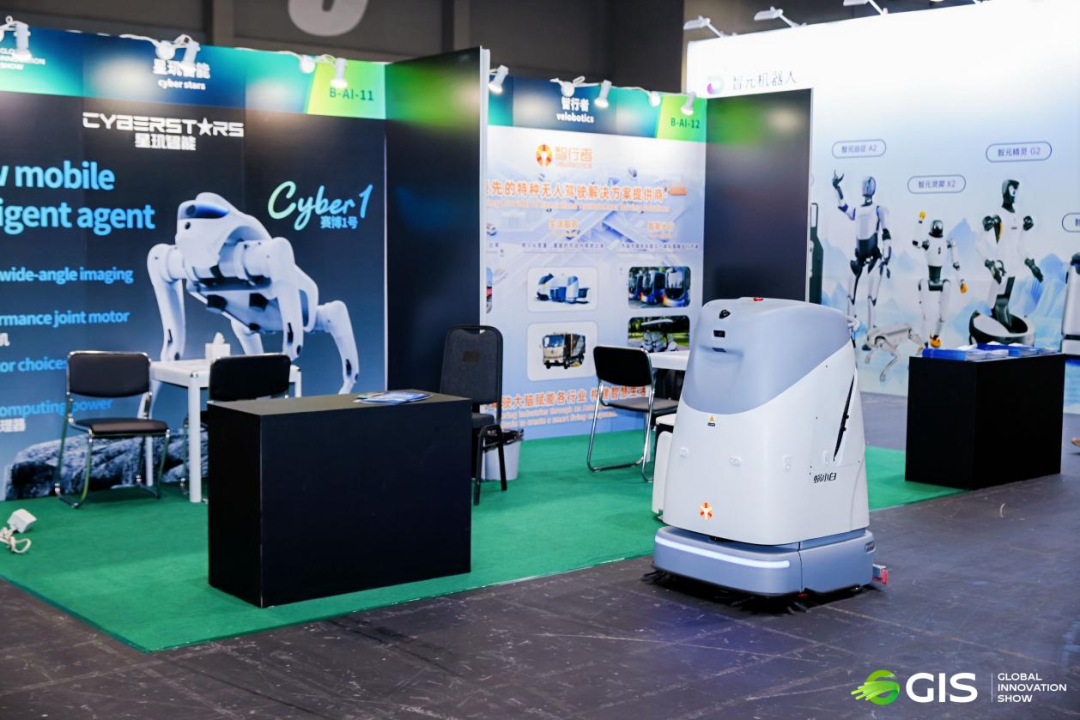
GIS
Velobotics in Action: Three-Tier Demand-
Oriented Layout & Near Break-Even Status
Based on its industry insights, Velobotics has formulated a commercial layout centered around three tiers of human needs:
Ensuring Life Safety
This tier corresponds to public safety scenarios, including firefighting and emergency rescue. Zhang Dezhao specifically cites the reflections sparked by a fire incident in Hong Kong: “How beneficial it would be if drones and robots could be deployed to conduct firefighting and rescue operations inside buildings.” Velobotics’ autonomous fire-fighting robots have been put into use in grasslands of northern China and mountainous areas of southern China. These robots can drag fire blankets to form fire barriers, enabling firefighters to operate remotely from a distance of 200 to 300 meters.
Liberating from Repetitive Labor
This tier covers scenarios such as sanitation, ports, and mining. Its sanitation robot sub-brand, WowoBot, has entered more than 100 cities across China and over 40 countries and regions worldwide, with a cumulative shipment volume approaching 10,000 units—“likely the best-selling single product in the L4 autonomous driving segment”.
Enhancing Travel Experience
Velobotics focuses primarily on Robobus instead of Robotaxi in this tier. Zhang Dezhao explains: “When passengers no longer need to drive, they will demand more interactive space inside the vehicle, and the future vehicle form may be closer to that of a minibus.” Velobotics has rolled out its vehicle-road-cloud integration solutions in over a dozen cities across China.
These achievements have enabled Velobotics to establish solid technological barriers: the company has filed more than 1,200 patents, “ranking first among domestic autonomous driving startups in terms of patent quantity without a doubt”; its cumulative commercial operation mileage has exceeded 120 million kilometers; and financially, the company is on the verge of break-even, “poised to become the first profitable autonomous driving enterprise in China”.
GIS
Industry Outlook: L4 Commercialization
Already Realized in Specific Scenarios
Zhang Dezhao concludes by emphasizing that the commercial application of high-level autonomous driving (L4) has already taken the lead in specific scenarios. “What I stress is commercial application, not pilot demonstrations,” he states unequivocally. “A scale of merely a few hundred vehicles is far from qualifying as commercial application.”
In his view, the industry is on the cusp of a transformative shift toward intelligence and connectivity. Significant progress has been made in sensors, algorithms, and vehicle-to-everything (V2X) technologies, paving the way for the gradual and rapid popularization of autonomous driving. “Single-vehicle intelligence is the initial stage of intelligent connected vehicles, while the intelligent connected vehicle solution will build a safer, more efficient, and healthier autonomous driving ecosystem.”
As a seasoned industry veteran with a decade of entrepreneurial experience, Zhang has witnessed and driven the evolution of autonomous driving technologies. His speech not only offers keen insights into technological trends but also reflects a pragmatic business acumen—remaining calm amid industry hype, staying the course amid controversies, and pursuing returns amid investments. This is precisely the rational voice that China’s autonomous driving industry needs as it transitions from technological exploration to commercial maturity.
With the 2027 economic parity milestone drawing near, Zhang Dezhao and his team at Velobotics are advancing steadily toward the commercial future of autonomous driving, one incremental yet solid step at a time.
